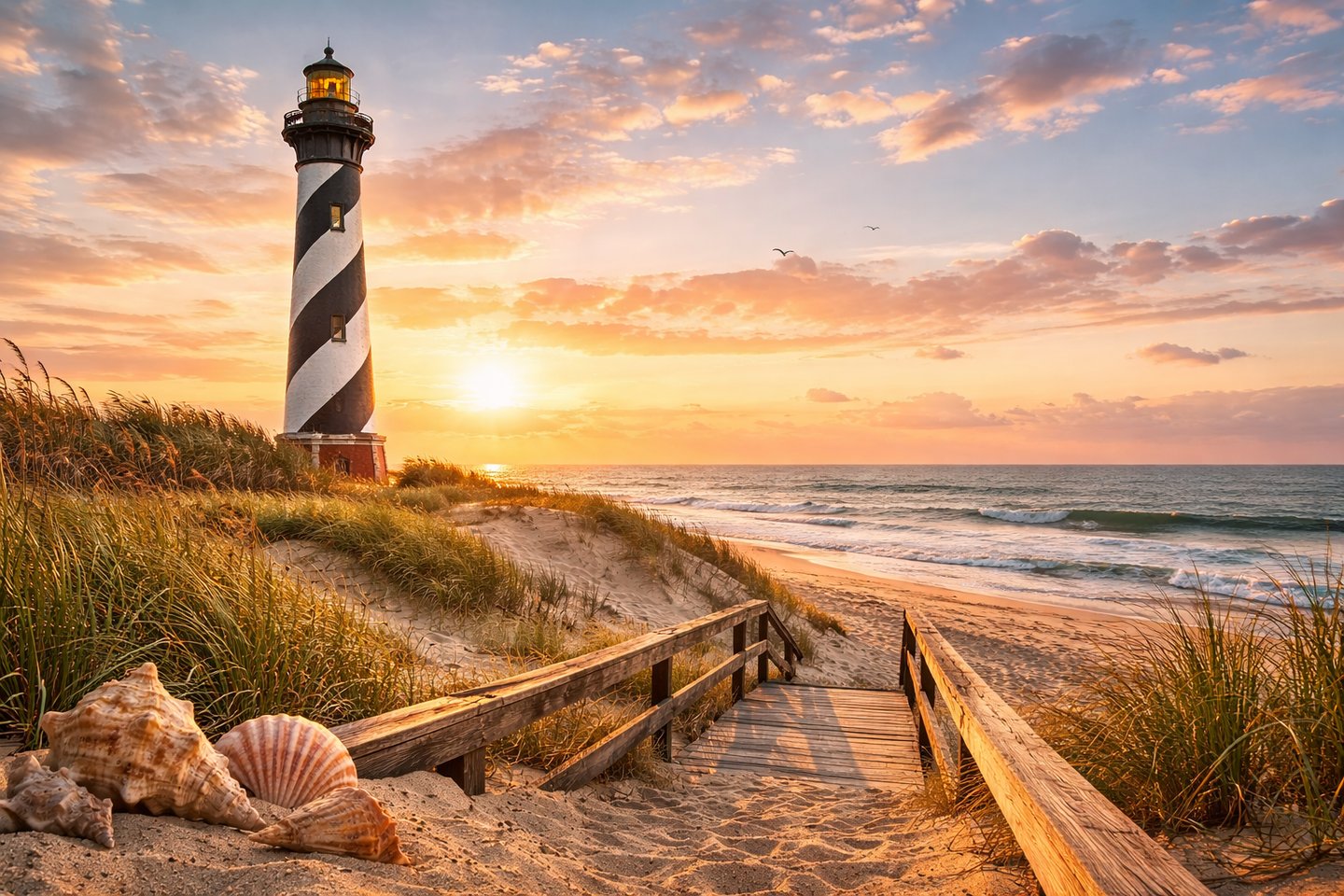
Cape Hatteras Lighthouse
Although Congress authorized a lighthouse at Cape Hatteras in 1794 because of the threat to Atlantic shipping, construction did not begin until 1799. The first lighthouse was lit in October 1803. Built of sandstone, it rose 90 feet high and was illuminated by a whale-oil lamp.
Despite its presence, the 1803 lighthouse did not do enough to protect ships from the dangerous Diamond Shoals. The tower was too short, its natural sandstone color blended with the background, and its light was too weak to be seen clearly by mariners. Poor construction and upkeep only added to the problem, and complaints about the lighthouse were common.
Cape Hatteras Lighthouse History
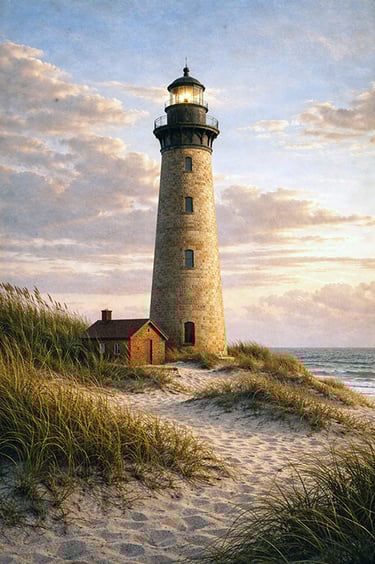
The Original Cape Hatteras Lighthouse, Built in 1803
The Original Cape Hatteras Lighthouse
The Cape Hatteras Lighthouse stands watch over one of the most treacherous sections of the Atlantic Coast. Just offshore, the Gulf Stream collides with the Virginia Drift, a branch of the Labrador Current from Canada, driving southbound ships toward the dangerous twelve-mile sandbar called Diamond Shoals. The many shipwrecks in these waters—numbering in the hundreds and possibly thousands—have earned this area its haunting name: the Graveyard of the Atlantic.
The First Renovation of the Cape Hatteras Lighthouse
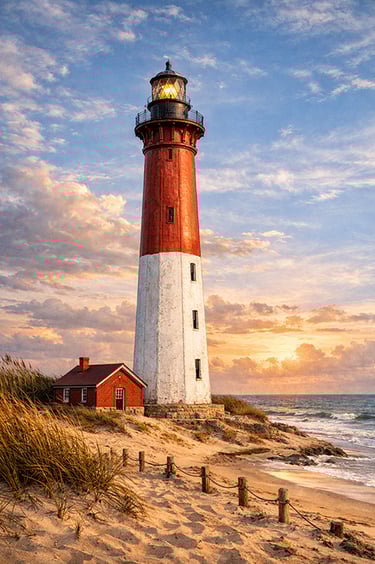
The Renovation of the Cape Hatteras Lighthouse, Completed in 1870.
In 1853, after studies conducted by the Lighthouse Board, it was decided that the Cape Hatteras lighthouse should be increased in height by 60 feet, bringing the tower to a total of 150 feet. The newly extended lighthouse was painted red above white, making it easier to recognize during the day. At the same time, it was fitted with a first-order Fresnel lens, which used both refraction and reflection to focus the light into a much stronger beam.
By the 1860s, the lighthouse needed major repairs, and Congress chose instead to fund the construction of a new tower. The Lighthouse Board prepared the plans and specifications, and work on the new lighthouse began in October 1868.
Because the lighthouse was built before modern pile drivers were perfected, construction crews faced an immediate challenge. Groundwater levels on the Outer Banks were very high, and when they dug the foundation pit, it filled with water at a depth of about four feet. To adapt to these natural conditions, foreman Dexter Stetson used a “floating foundation” for the Cape Hatteras Lighthouse. Layers of yellow pine timbers, each measuring 6 by 12 feet, were laid crosswise in the pit below the water table, and granite plinths were then placed on top of the timbers.
The new lighthouse was first lit on December 16, 1870, and the original 1803 lighthouse was demolished in February 1871. In 1873, the Cape Hatteras Lighthouse received its famous black-and-white spiral daymark. The Lighthouse Board gave each lighthouse a distinctive daytime paint pattern, called a daymark, and a unique nighttime light sequence, called a nightmark, so mariners could identify it from every other lighthouse along the coast.
The lighthouse is a tapered brick tower rising from an octagonal base of brick and granite and crowned with an iron-and-glass lantern. It is the tallest brick lighthouse in the United States, standing 198.49 feet from the bottom of its foundation to the top of the tower’s pinnacle. Its exceptional height was necessary to extend the reach of its light from the low-lying beach site. The tower’s strong design features both exterior and interior brick walls, along with interstitial walls arranged like the spokes of a wheel. From the ground to the lens room, there are 269 steps.
The Fresnel lens installed in the 1870 lighthouse was fueled by kerosene and could be seen from about 16 miles offshore. Each day, the keeper had to manually rewind the clockwork mechanism that rotated the lens, which typically completed one full cycle every 12 hours. When the light was electrified in 1934, the manual system was no longer needed. After vandals damaged the massive glass Fresnel lens, it was replaced in 1950 with a modern aero beacon. Today, the light rotates using electricity, and a photocell automatically switches it on and off.
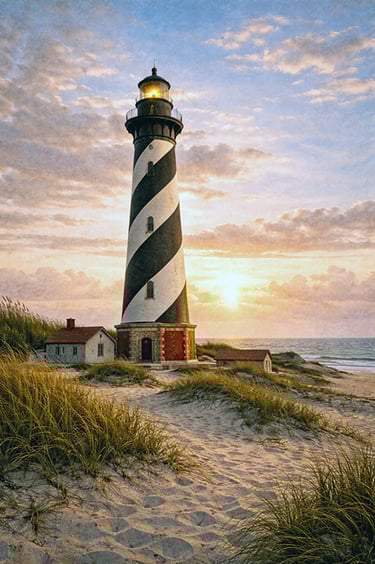
Black and White Stripe Daymark Pattern painted in 1873 for the Cape Hatteras Lighthouse.
On January 23, 1950, the Coast Guard returned the 250,000-candlepower beacon to the Cape Hatteras Lighthouse after the shoreline had built back up in front of the tower. In 1972, the light was strengthened to 800,000 candlepower. From the 1960s through the 1980s, work continued to protect and stabilize the beach as erosion became a concern once again. In March 1980, a winter storm destroyed the remaining traces of the 1803 lighthouse and caused serious erosion to the dunes.
In 1999, after years of research and debate, the Cape Hatteras Light Station was moved to its present location. The lighthouse traveled 2,900 feet in 23 days and now stands 1,500 feet from the shoreline, the same distance it had originally. The Double Keepers’ Quarters, the Principal Keeper’s Quarters, the cisterns, and the oil house were relocated as well.
Today, the National Park Service cares for the lighthouse and the keepers’ quarters, while the U.S. Coast Guard continues to operate and maintain the automated beacon.
Cape Hatteras Lighthouse
46379 Lighthouse Rd
Buxton, NC 27920
Hours
Monday - Sunday
9am - 4:30pm
Contacts
252-473-2111
Cape Hatteras Lighthouse National Park Service
The Cape Hatteras Lighthouse is being restored, and will not be open for climbing. Expect to reopen in 2027.
In 1999, the Cape Hatteras Light Station, which includes seven historic structures, was successfully relocated 2,900 feet from the site it had occupied since 1870. Threatened by shoreline erosion, a natural coastal process, the entire station was carefully moved to a safer location.
The historic buildings and cisterns were then arranged in the same spatial and elevational relationships they had at the original site. Although the National Park Service succeeded in balancing historic preservation with coastal protection, the highly publicized move of the station—especially the lighthouse—sparked intense debate and drew national attention.
The Relocation of the Cape Hatteras Lighthouse
Preserving the Cape Hatteras Lighthouse
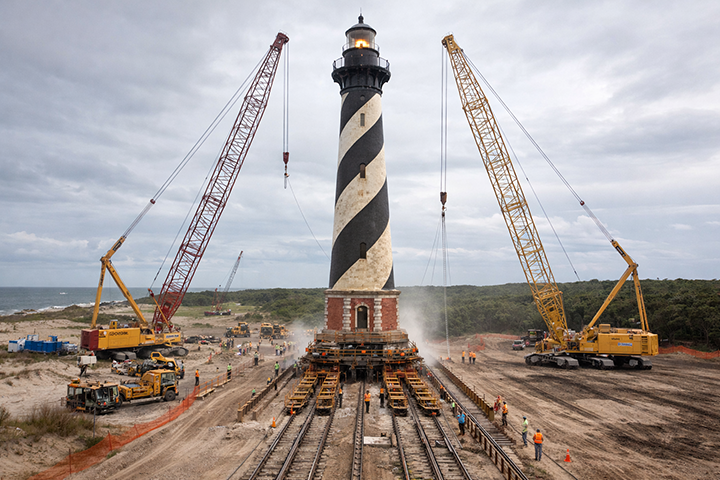
The Cape Hatteras Lighthouse was relocated in 1999.
FAQ
Frequently Asked Questions
How far was the ocean from the Cape Hatteras Lighthouse when it was built?
At the time it was built in 1870, the lighthouse stood roughly 1,500 feet from the shoreline.
How tall is the Cape Hatteras Lighthouse?
The Cape Hatteras Lighthouse is the tallest brick lighthouse in America and stands 208 feet tall.
Is the lighthouse open for climbing?
No. The Cape Hatteras Lighthouse is currently closed to visitors while important restoration and rehabilitation work is being completed. The lighthouse will remain closed for climbing throughout 2026.
Can I still visit the Cape Hatteras Lighthouse grounds?
Yes. Visitors are welcome to explore the outdoor grounds surrounding the Cape Hatteras Light Station, which remain open year round to the public.
How far does the Cape Hatteras Lighthouse light project?
The Cape Hatteras Lighthouse remains an active aid to navigation, illuminating the coast each night. Its powerful beam can be visible from as far as 20 miles offshore and produces a flash every 7.5 seconds.