Ocracoke Lighthouse
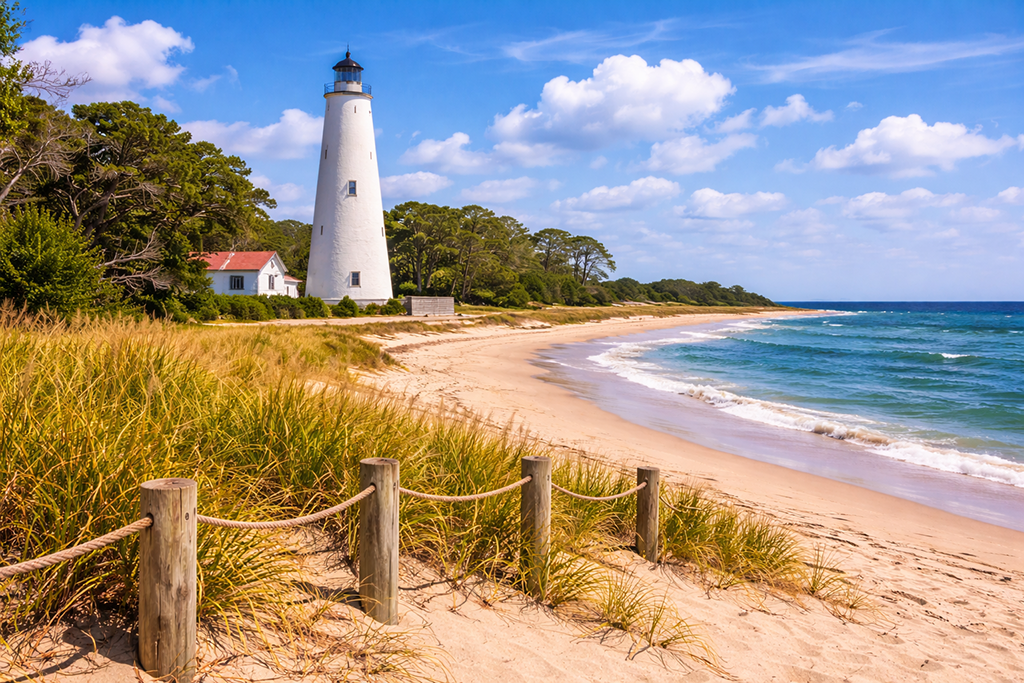
Built in 1823, the Ocracoke Lighthouse is the oldest operating lighthouse in North Carolina and one of the oldest still-active lighthouses in the United States. Unlike the other Outer Banks lighthouses, Ocracoke serves as an inlet light, helping guide boats safely through Ocracoke Inlet and its ever-shifting shoals. Because the inlet continues to change over time, the lighthouse still plays an important role today.
While the tower is not open for climbing, the grounds are open to visitors each day. Parking at the site is limited to just a few standard spaces and one accessible space, so many visitors find it easiest to walk over from the Ocracoke Island Visitor Center.
Ocracoke Lighthouse History
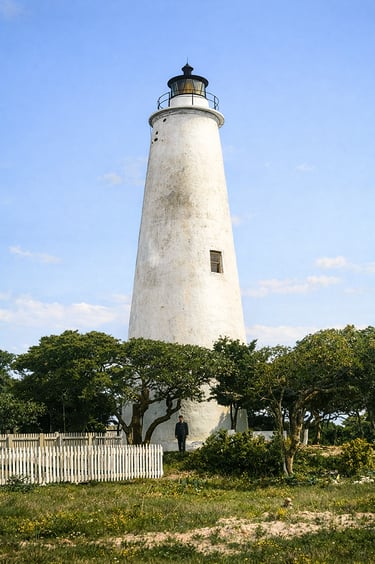
The Original Ocracoke Lighthouse, Built in 1823
A historic beacon at the heart of Ocracoke Inlet
How a shifting inlet shaped Ocracoke’s maritime history
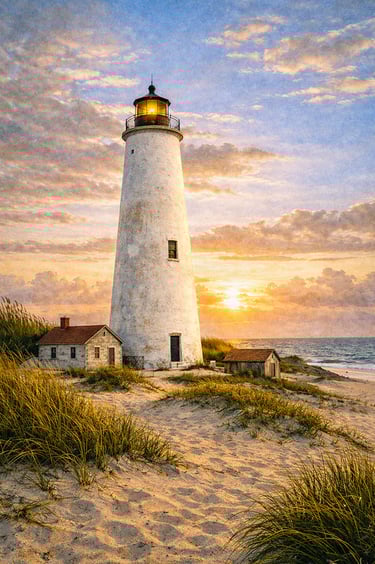
Today's version of the 75 feet tall Ocracoke Lighthouse as seen at sunset.
Ocracoke Inlet first entered recorded history in 1585, when English explorers ran a sailing ship aground there. Over the next two centuries, the inlet grew into one of the most important maritime passages on the East Coast. For many years, it served as the most practical route for ships traveling to inland ports such as Elizabeth City, New Bern, and Edenton. Its importance also helped give rise to Ocracoke Village, originally known as Pilot Town, where skilled pilots settled in the 1730s to guide vessels through the inlet’s constantly changing channels.
As traffic through the inlet increased, the need for a reliable navigational aid became clear. In 1798, a wooden, pyramid-shaped lighthouse was built on nearby Shell Castle Island to help mariners find a safe passage. But the inlet’s shifting channel quickly made that structure ineffective, and within less than twenty years it was already outdated. By 1818, the main channel had moved nearly a mile away, and that same year both the lighthouse and the keeper’s house were destroyed by lightning.
Even so, the need for a beacon remained. A new Ocracoke Lighthouse was built in 1822 and first illuminated in 1823, providing a lasting guide for vessels entering the inlet. In 1854, its original reflector system was upgraded with a fourth-order Fresnel lens, whose precision-cut glass prisms greatly strengthened the light and improved visibility for mariners navigating these challenging waters.
Today, the lighthouse operates automatically, so there is no longer a need for a full-time keeper on site. The U.S. Coast Guard manages the light itself, while the National Park Service cares for and protects the historic lighthouse.
Stewardship of a historic beacon
How the Fresnel lens transformed lighthouse navigation
For more than 2,000 years, mariners have relied on navigational lights to help guide them at sea. As shipping and coastal trade expanded, lighthouse technology advanced as well. Simple wooden platforms gradually gave way to stronger brick and metal towers, while brighter oil lamps replaced basic wood or coal fires. Reflectors were also introduced to gather and strengthen the light, making it visible from greater distances. One of the most important breakthroughs came in 1822, when French physicist Augustin-Jean Fresnel developed a revolutionary new lens for lighthouses.
The Fresnel lens looked like a giant glass beehive, made up of carefully arranged prisms set inside a brass frame. These prisms bent and concentrated light into a focused beam, instead of allowing it to scatter in every direction. This made the lens far more efficient than earlier systems. An open flame could lose nearly all of its light, and even lamps with reflectors wasted a significant amount. By comparison, a Fresnel lens captured and directed much more of the light, allowing it to shine dramatically farther. Before its invention, the brightest lighthouse beams could typically be seen only 8 to 12 miles away. With a Fresnel lens, the light could reach all the way to the horizon—more than 20 miles away.
The Fresnel lens also improved safety by making lighthouse signals easier to identify. Earlier lighthouses often displayed a steady, unchanging light, which could make one beacon look much like another. This sometimes created confusion for ships traveling at night or in poor weather. Because the Fresnel lens could be designed with different flash panels and rotating speeds, it allowed each lighthouse to display its own distinct light pattern, giving mariners a more reliable way to tell one beacon from the next.
From oil storage to modern support building
This small masonry structure once served as the storage space for the fuels that kept the lighthouse shining. Over the years, the light was powered by several different sources, including whale oil, porpoise oil, and later mineral oil, better known as kerosene. Today, the lighthouse runs on electricity, and the building has been repurposed to hold an auxiliary generator that supports the light’s operation.
Cape Lookout Lighthouse
360 Lighthouse Rd
Ocracoke, NC 27960
Hours
The grounds are open all year for viewing.
The Lighthouse is not accessible
Contacts
252-473-2111

FAQ
Frequently Asked Questions
Is the Ocracoke Lighthouse open for climbing?
Because of the age and condition of the structure—especially its narrow spiral staircase—the Ocracoke Island Lighthouse is not open for climbing. At nearly 200 years old, it remains one of North Carolina’s oldest surviving lighthouses and is the second oldest lighthouse in the state.
How tall is the Ocracoke Lighthouse?
The Ocracoke Lighthouse stands approximately 75 feet tall.
How far is the light from the Cape Lookout Lighthouse visible?
The light is visible at approximately 16 miles out to sea. This is one of the few lighthouses that continues to operate even during the day. Its fourth-order Fresnel lens casts a steady white beam that has guided vessels through these waters since 1823.
Why is the Ocracoke Lighthouse all white?
The Ocracoke Island Lighthouse owes its bright white appearance to a distinctive exterior coating applied when it was built in the 1820s. Rather than using ordinary paint, builders covered the brick tower with a mixture of lime, salt, ground rice, whiting, clear glue, and boiling water. That unusual finish gave the lighthouse its signature look and makes it the only white lighthouse on the Outer Banks.
What’s the easiest way to get to the Ocracoke Island Lighthouse?
Because parking near the lighthouse is very limited and summer crowds can be heavy, many visitors find it easiest to walk or bike from one of the main parking areas in Ocracoke Village. Convenient parking is available near the Ocracoke Visitors Center and the Ocracoke Preservation Museum, and from either location, the lighthouse is less than a mile away.