Cape Lookout Lighthouse
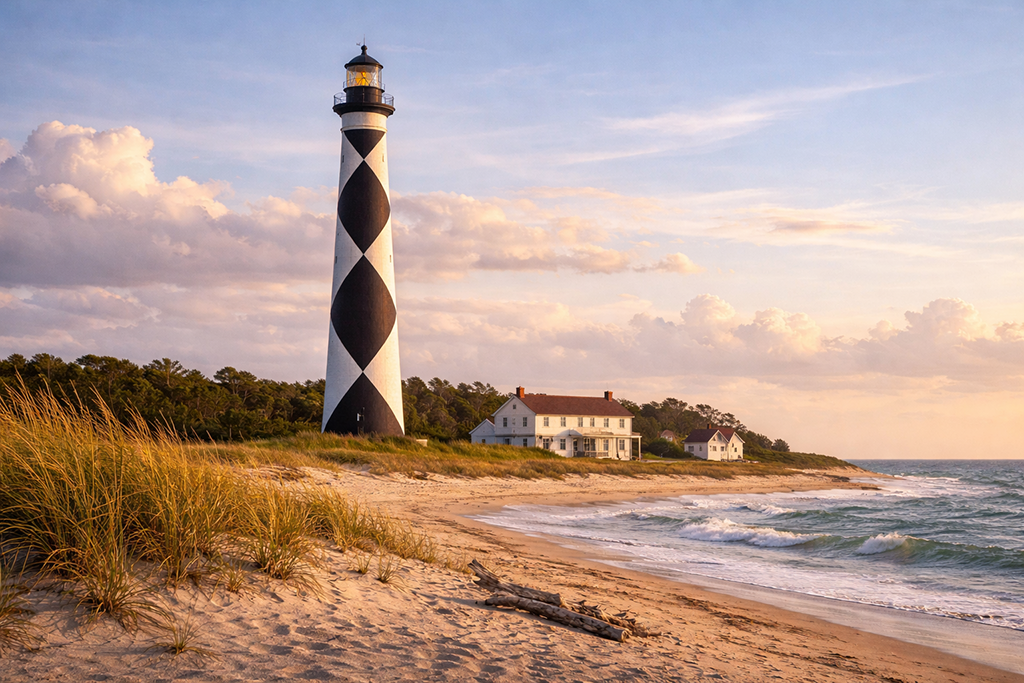
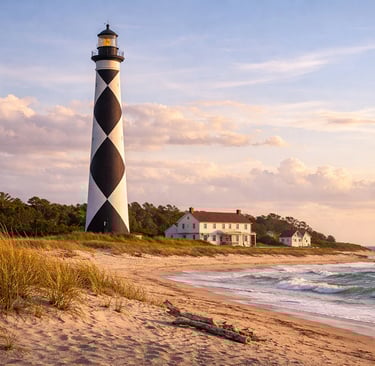
Located on North Carolina’s beautiful Core Banks, the Cape Lookout Lighthouse has helped guide mariners past dangerous offshore shoals for generations. The first lighthouse at this site was completed in 1812, and the current 163-foot brick tower was finished in 1859. In 1873, its now-famous black-and-white diamond pattern was added, giving the lighthouse its distinctive appearance and helping sailors recognize it from other coastal beacons.
Known for its distinctive black-and-white diamond design, the Cape Lookout Lighthouse looks a little different from each direction. Set on the unspoiled Core Banks, this remote lighthouse is only accessible by boat, adding to its charm and sense of adventure.
Cape Lookout Lighthouse History
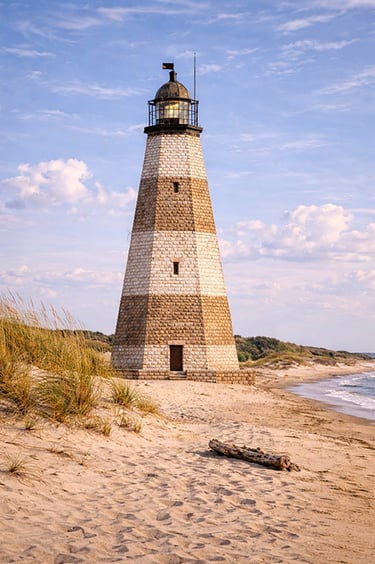
The Original Cape Lookout Lighthouse, Built in 1812
The Original Cape Lookout Lighthouse
The Rebuilding of the Cape Lookout Lighthouse
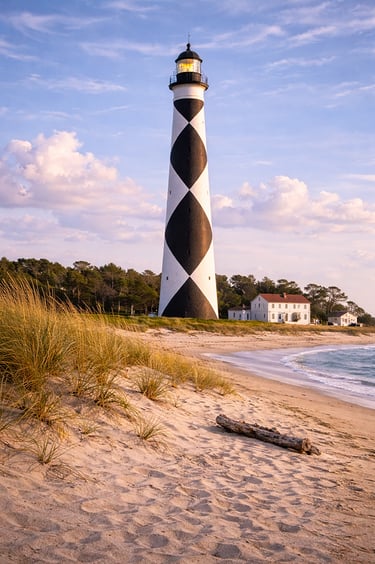
The newly rebuilt Cape Lookout Lighthouse, Completed in 1859.
Soon after the original Cape Lookout Lighthouse was finished in 1812, officials realized it was not effective enough to properly warn mariners about the hazards of Lookout Shoals. Almost fifty years later, following important changes within the Lighthouse Board, a new and taller lighthouse was completed. This improved tower provided a much stronger warning to ships navigating the North Carolina coast.
The lighthouse visitors see today began its service on November 1, 1859, when the second Cape Lookout Lighthouse was completed and lit. Built to replace the shorter 1812 tower, this new lighthouse featured a double-wall design—the first in North Carolina—which allowed it to rise much higher than earlier structures. Equipped with a first-order Fresnel lens, the 163-foot tower projected its light roughly 15 miles offshore.
Its early years, however, were shaped by the Civil War. Soon after the improved lighthouse went into service, the light was turned off so Union ships could not use it to navigate the dangerous coastline. In 1863, the beacon was restored with a third-order Fresnel lens and remained in operation for most of the war.
Following the war, the original Fresnel lens was sent to France for repairs and reinstalled in 1867. The iron staircase, which had been damaged in a Confederate raid, was repaired that same year, marking another important step in the lighthouse’s recovery,
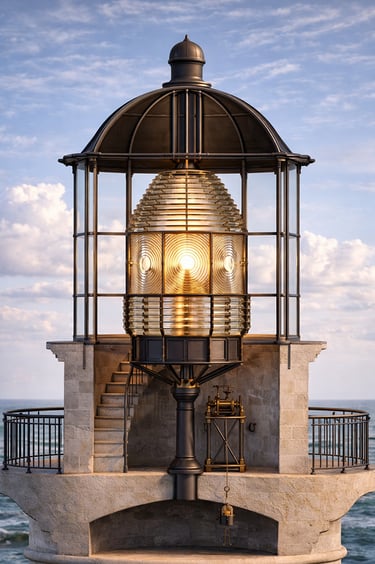
Fresnel Lens at the Cape Lookout Lighthouse.
Over the years, Cape Lookout Lighthouse has evolved along with lighthouse technology. The lamp was first powered by whale oil, but in 1873 the Lighthouse Board changed to mineral oil, or kerosene, as a more practical fuel source. In 1912, the wick lamp was upgraded to an incandescent oil vapor lamp, making the light visible up to 19 miles offshore. Electric lights were installed in 1933, powered by on-site generators. Even then, keepers were still needed to watch over the equipment and keep everything running.
That changed in 1950, when the light was automated and the era of lighthouse keepers at Cape Lookout came to a close. The beacon could now switch itself on and off, while Coast Guard personnel took over responsibility for the generators. In 1975, the original Fresnel lens, after more than a century of service, was replaced by two aero beacons.
Power Solution for the Cape Lookout Lighthouse
The lighthouse continued using generator power until 1983, when an underwater cable from Harkers Island finally brought a steadier source of electricity. With that change, the Cape Lookout Light Station was officially decommissioned, and oversight moved to the U.S. Coast Guard Station at Fort Macon.
In 2003, the Coast Guard transferred the lighthouse and its remaining property to the National Park Service, opening the door for visitors to climb the tower. Today, the Park Service manages the site, and the Coast Guard still maintains the working light.
Flash Patterns for the Cape Lookout Lighthouse
When it was first finished in 1859, the second Cape Lookout Lighthouse looked much simpler than it does today. Like several other North Carolina lighthouses of the time, it was built as a plain red brick tower. Later, the Light House Board decided that each coastal lighthouse should have its own unique daytime appearance, known as a daymark, so mariners could tell them apart just as they did by light patterns at night. In 1873, Cape Lookout was painted with its now-famous black-and-white diamond pattern, giving it the distinctive look visitors recognize today.
Its light changed over time as well. At first, the lighthouse showed a steady white beam. In 1914, a clockwork-powered occulting device was installed, creating a flashing signal that made the lighthouse easier to identify after dark. When electric lamps were added in 1933, the light could flash directly by turning on and off. Today, Cape Lookout’s light continues its long tradition of guiding mariners with a flash every 15 seconds.
Cape Lookout Lighthouse
1800 Island Rd
Harkers Island, NC 28531
Hours
Friday - Saturday
5:30am - 8:30pm
Contacts
252-728-2250
For information regarding cabin rentals or ferry schedules, it is best to contact the authorized concessioners directly.
FAQ
Frequently Asked Questions
Is the Cape Lookout Lighthouse open for climbing?
Yes the Cape Lookout Lighthouse is open for climbing from mid-May to mid September, 10:15 am to 4pm. Tickets should be purchased the day of the climb at the Light Station Visitor Center, located near the Cape Lookout Lighthouse. View our Blog article for more info: Can You Climb the Outer Banks Lighthouses?
How tall is the Cape Lookout Lighthouse?
The Cape Lookout Lighthouse is a brick lighthouse that stands 163 feet tall. For more info visit: Details About Cape Lookout Lighthouse.
How far is the light from the Cape Lookout Lighthouse visible?
The light is visible at least 12 miles out to sea and up to 19 miles. This is one of the few lighthouses that continues to operate even during the day.
Can I still visit the Cape Lookout Lighthouse grounds?
Yes. Visitors are welcome to explore the outdoor grounds surrounding the Cape Lookout Lighthouse, which remain open year round to the public.
How far does the Cape Lookout Lighthouse light project?
The Cape Lookout Lighthouse remains an active aid to navigation, illuminating the coast each night and day. Its powerful beam can be visible from as far as 20 miles offshore and produces a white flash every 15 seconds.