Currituck Beach Lighthouse
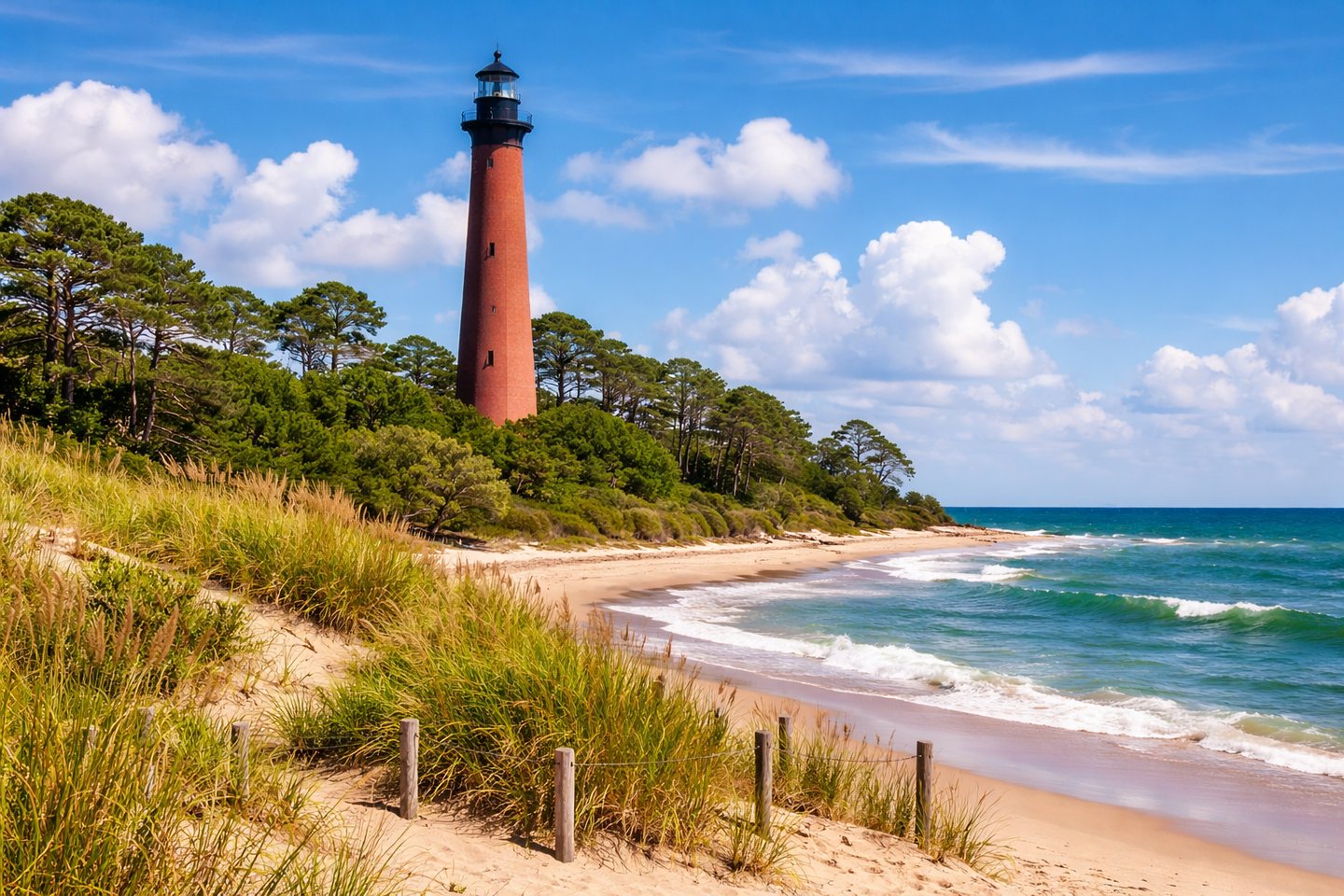
The story of Currituck Beach Lighthouse began in 1873, when Congress approved funding for a new beacon along the remote northeastern coast of North Carolina. The tower was built to illuminate the last 40-mile stretch of dark shoreline between Cape Henry, Virginia, and Bodie Island Light.
Currituck Beach Lighthouse History
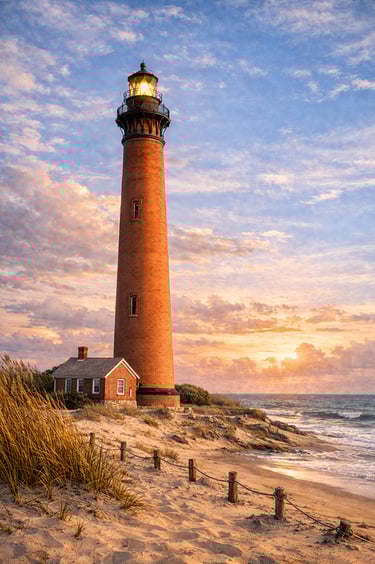
The Currituck Beach Lighthouse, Built in 1875
The Last Great Lighthouse Tower
When it was completed in December 1875, Currituck Beach Lighthouse also became the last great lighthouse tower constructed on the Outer Banks. Its powerful beam reached 18 nautical miles out to sea, guided each night by devoted keepers who helped mariners navigate this once-shadowed stretch of coast.
How Currituck Beach Lighthouse Completed the Coastline
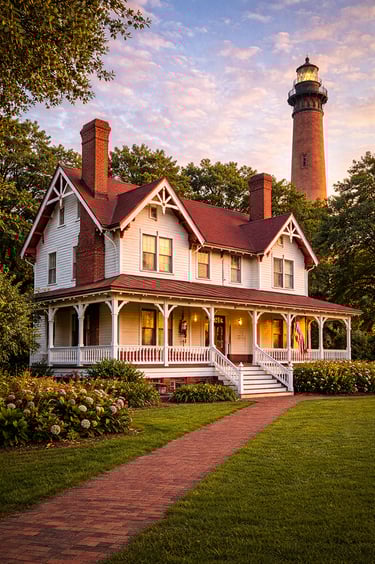
Lighthouse Keepers House at Currituck Beach Lighthouse
On December 1, 1875, the beam from Currituck Beach Lighthouse finally illuminated the last remaining stretch of dark coastline between Cape Henry to the north and Bodie Island to the south. It was the final major brick lighthouse built on the Outer Banks, and unlike many other towers in the region, its exterior was never painted. That natural red-brick finish still gives visitors a closer look at the craftsmanship and materials that shaped this remarkable structure.
Currituck Beach Lighthouse is classified as a first-order lighthouse, meaning it was equipped with the largest of the seven Fresnel lens sizes. Its original light source was an oil lamp with five concentric wicks, the largest measuring four inches across. To create its distinctive flash, the massive lens assembly had to rotate, powered by a weight-and-cable clockwork system similar to the inner workings of a grandfather clock. The lighthouse was electrified in the 1930s, but its familiar 20-second flash pattern—three seconds of light followed by seventeen seconds of darkness—remains in use today. Each evening at dusk, the beacon turns on automatically and shines up to 18 nautical miles, helping mariners both avoid danger and identify their location along the coast.
Life at the Lighthouse Keeper’s Station
The Lighthouse Keeper’s House, a charming Victorian Stick-style residence, was built from pre-cut, numbered materials shipped in by the U.S. Lighthouse Board on a barge and assembled on site. When the home was completed in 1876, two lighthouse keepers and their families shared the duplex in this remote coastal setting.
During the five decades when the lighthouse operated by oil, twenty-one men served as keepers. Until 1921, the station was staffed by one head keeper and two assistants; after that, the principal keeper worked with just one assistant. Their duties were constant and demanding: hauling fuel up the tower, cleaning the lens, trimming the wicks, and winding the clockwork mechanism that rotated the light every two and a half hours. If the light ever failed, dismissal could follow. Beyond tending the beacon, the keepers and their families also cared for livestock, maintained gardens, and looked after the station grounds and buildings.
When the station was first established, the landscape looked far different from what visitors see today. Much of the shade and greenery now surrounding the site had not yet taken root, leaving the keeper’s dwelling, outbuildings, and lighthouse rising directly from the sand on a deep, sturdy foundation. From the station, there were open views of both the Atlantic Ocean and the Currituck Sound. An 1885 coastal guide described the area as a long, nearly uninterrupted stretch of bright sand, shaped by rolling dunes and scattered here and there with small clusters of trees and patches of woods.
Currituck Beach Lighthouse
1101 Corolla Village Road
Corolla, NC 27927
Hours
Monday - Sunday
9:00am - 5:00pm
Contacts
252-453-4939
obcinc.org
2026 Season: March 21 - November 30
During the summer season, hours may extend to 8 pm.
Currituck Beach Lighthouse rises above Historic Corolla Village as one of the northern Outer Banks’ most recognizable landmarks. The last brick-and-mortar lighthouse built in North Carolina, its unpainted red-brick exterior was intentionally left natural so mariners could easily distinguish it from other coastal beacons during the day.
Inside, visitors can explore exhibits that highlight the lighthouse’s history, its engineering, and its important place in both Outer Banks culture and American maritime heritage. As a first-order lighthouse, it features the largest of the seven Fresnel lens sizes, and its signature light can still be seen from 18 nautical miles away on a 20-second flash cycle.
For many visitors, the climb is the highlight of the experience. At the top, sweeping views of the Atlantic Ocean, Currituck Sound, and the northern Outer Banks make the effort well worth it.
The Iconic Currituck Beach Lighthouse
A towering red-brick landmark in Historic Corolla Village
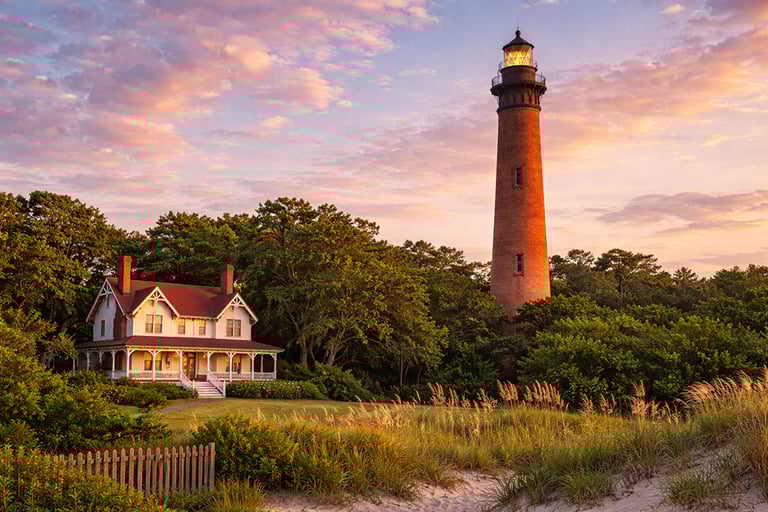
The Currituck Beach Lighthouse and Keeper's Station.
FAQ
Frequently Asked Questions
How far is the ocean from the Currituck Beach Lighthouse?
The shoreline is just a stroll away from the Currituck Beach Lighthouse, about half a mile or less.
How tall is the Currituck Beach Lighthouse?
The Currituck Beach Lighthouse stands 162 feet tall from the ground to its top.
Is the Currituck Beach Lighthouse open for climbing?
Yes. The Currituck Beach Lighthouse is open to visitors climbing the 220 steps to reach the top of the lighthouse. The 2026 Season to explore and climb the Lighthouse interior is: March 21 - November 30. Admission cost is $13 per person. Children ages 0 to 3 years old are free. Parking is free. Tickets must be purchased in person at the lighthouse
Can I still visit the Currituck Beach Lighthouse grounds?
Yes. Visitors are welcome to explore the outdoor grounds surrounding the Currituck Beach Lighthouse, which remain open year round to the public. The 2026 Season to explore and climb the Lighthouse interior is: March 21 - November 30.
How far does the Currituck Beach Lighthouse light project?
The Currituck Beach Lighthouse remains an active aid to navigation, illuminating the coast each night. Its powerful beam can be visible from as far as 20 miles offshore and produces a 3 second flash every 17 seconds.