Details About Cape Lookout Lighthouse
Explore Cape Lookout Lighthouse in North Carolina, including its history, diamond daymark, remote island setting, and current visitor tips.
OUTER BANKS LIGHTHOUSES
Red Rhyder
3/13/20264 min read
Details About Cape Lookout Lighthouse
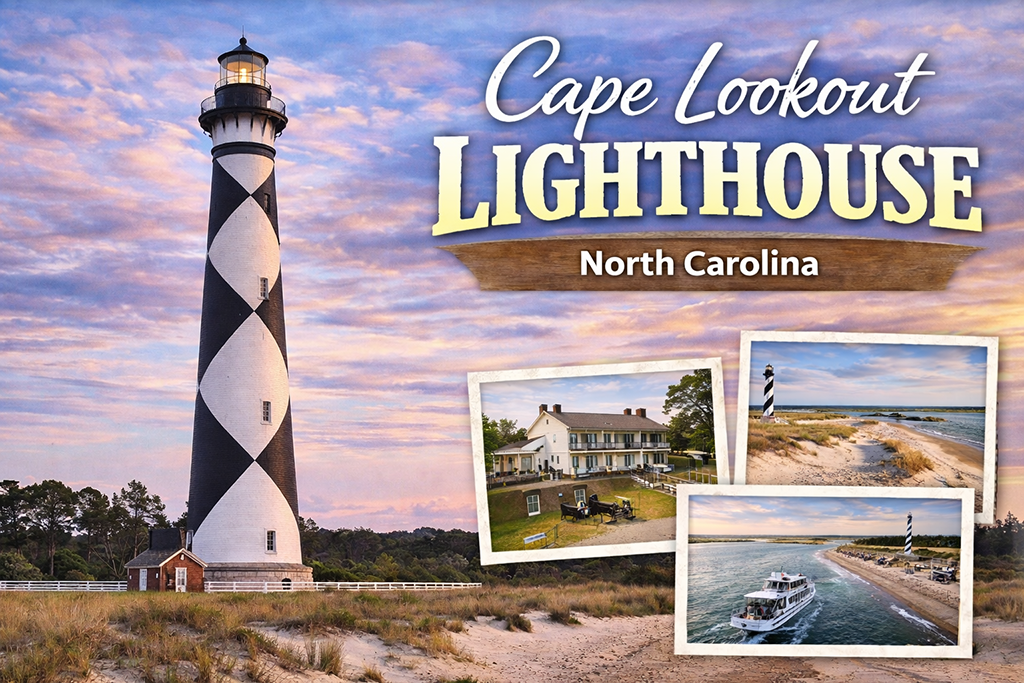
Cape Lookout Lighthouse is one of North Carolina’s most recognizable coastal landmarks, but it feels very different from some of the better-known Outer Banks lighthouse stops. It stands on South Core Banks within Cape Lookout National Seashore, part of the Crystal Coast, and reaching it is part of the adventure because the area is accessible only by boat or passenger ferry. That remote setting is a big reason the lighthouse feels wild, scenic, and memorable.
What many visitors notice first is the lighthouse’s bold black-and-white diamond pattern. That distinctive look has made Cape Lookout one of the most photographed beacons in the state, but the tower’s real story is even more interesting. It combines early lighthouse history, Civil War-era disruption, a unique architectural design, and a modern preservation effort that is still shaping the visitor experience today.
History
Cape Lookout’s lighthouse story began early in the 19th century. Congress authorized a lighthouse “on or near the pitch of Cape Lookout” in 1804, and the first tower was completed in 1812. According to the National Park Service, that original lighthouse was a wood-frame octagonal tower with a brick stairwell, red-and-white horizontal stripes, and a light whose focal plane was 96 feet above ground.
Over time, mariners complained that the first lighthouse was not effective enough. The NPS timeline notes that by the 1850s it had become clear that a taller, more stable lighthouse was needed, and Congress appropriated money for a replacement in 1857. The current lighthouse was completed and first lit on November 1, 1859.
The second lighthouse quickly became part of Civil War history. After North Carolina joined the Confederacy in 1861, the lenses from coastal lighthouses were removed so Union ships could not use them for navigation. The light was later reestablished with a third-order Fresnel lens in 1863, and the original lens was repaired and reinstalled after the war in 1867.
Cape Lookout’s famous daymark came a little later. The National Park Service says that in 1873, as other tall red-brick lighthouses were being built along the North Carolina coast, the Lighthouse Board assigned each tower a unique daytime color pattern. That is when Cape Lookout received the black-and-white diagonal checker or diamond design it is known for today.
Architecture
The current Cape Lookout Lighthouse was a major upgrade over the first tower. NPS describes it as 163 feet tall, with a double-wall structure that was the first of its kind in North Carolina. That design allowed it to rise much higher than earlier towers and better warn mariners about Lookout Shoals.
The lighthouse originally used a first-order Fresnel lens, one of the most powerful lens types used in major coastal beacons. NPS says the 1859 light could be seen approximately 15 miles out to sea, while the timeline page notes that in good weather the fixed light could be seen 18 miles away. Either way, the lighthouse was built to be a far more effective warning system than the shorter 1812 tower.
Its most famous design feature is still the diamond daymark. Unlike the spiral stripes at Cape Hatteras or the horizontal bands at Bodie Island, Cape Lookout’s pattern feels bold and geometric. Visit North Carolina identifies that black-and-white diamond pattern as the lighthouse’s defining visual trait, and it is one reason the tower stands out so strongly in photos and from a distance.
The setting around the lighthouse matters just as much as the tower itself. Cape Lookout sits on a remote barrier island, surrounded by dunes, beach, and maritime landscape. The light station historically included supporting buildings such as keeper housing and work structures, and the NPS notes that the light station was listed on the National Register of Historic Places in 1972.
Why Cape Lookout Lighthouse Is Special
One reason Cape Lookout feels different from other lighthouse visits is its sense of isolation. Visit North Carolina describes it as one of the most remote major coastal landmarks in the region, and that remoteness gives the whole experience a quieter, more natural feel. The boat ride over, the undeveloped shoreline, and the wide-open beach all make the lighthouse visit feel more like an outing into a wild seashore than a quick roadside stop.
It is also part of a much larger protected landscape. Cape Lookout National Seashore includes 56 miles of undeveloped barrier-island beach, and the park notes that even a day trip requires some planning. That bigger context is part of the appeal: many visitors come for the lighthouse, then stay for shelling, swimming, wildlife watching, or exploring the surrounding seashore.
Visitor Tips
The most important current detail is that the lighthouse itself is closed to visitors during restoration. NPS says safety inspections in 2021 found structural issues with the stairs and handrails, leading to a major stabilization project. During that work, the lighthouse remains closed to visitors for safety, and the project is expected to take two to three years.
Even though the tower is closed for climbing, the lighthouse area is still worth visiting. The NPS lighthouse visit page says visitors can walk the boardwalk, head to the pedestrian beach, and look for the remains of the original 1812 lighthouse foundation in the sand between the current tower and the boardwalk. The Keeper’s Quarters Museum is open from mid-March through the end of October, and the Light Station Visitor Center operates seasonally on South Core Banks.
Getting there takes a little preparation. Cape Lookout National Seashore says the islands can be reached by authorized ferry, private boat, kayak or canoe, or certain tour services, and there are no bridges to the islands. The Harkers Island Visitor Center is the easiest mainland starting point for many travelers and is open daily from 9:00 a.m. to 5:00 p.m. during the summer season, with reduced winter hours.
There is also a current access issue worth checking before you go. As of the latest NPS alerts, the passenger ferry dock servicing the Cape Lookout Lighthouse area is closed for repairs, visitors must use an alternative route on the beach, and ferry boarding or disembarking may take longer than normal. NPS also notes that while the dock remains in limited service, it is not wheelchair accessible.
Cape Lookout is best for visitors who enjoy a more natural, less built-up coastal experience. The park’s planning pages note that the islands are largely undeveloped, with no paved roads, concession stands, bathhouses, camp stores, or trash cans beyond the ferry landing areas. That means bringing water, sun protection, and anything else you need for the day is a smart idea.
Cape Lookout Lighthouse is more than a beautiful black-and-white tower. It is a landmark shaped by early navigation needs, 19th-century engineering, Civil War disruption, and an ongoing effort to preserve it for the future. Its remote island setting makes it feel different from many other North Carolina lighthouse stops, and that is exactly why so many visitors remember it so vividly.