Details About Bodie Island Lighthouse
Explore Bodie Island Lighthouse in Nags Head, NC, including its history, striped design, climb details, and visitor tips for your Outer Banks trip.
OUTER BANKS LIGHTHOUSES
Jim Kernodle
3/13/20264 min read
Details About Bodie Island Lighthouse
Bodie Island Lighthouse is one of the most photographed landmarks on the Outer Banks, and it is easy to see why. Rising above marshland near Nags Head, the tower’s bold horizontal black-and-white stripes make it instantly recognizable. It feels classic, dramatic, and a little quieter than some of the more heavily talked-about lighthouse stops in the region.
What makes Bodie Island especially appealing is that it offers more than a quick photo stop. The setting includes marsh boardwalks, views of the surrounding water and maritime landscape, and a climb that gives visitors a chance to see Bodie Island, the Atlantic Ocean, and Pamlico Sound from above. That combination of scenery, history, and accessibility is a big reason it remains one of the best lighthouse visits on the Outer Banks.
History
The history of Bodie Island Lighthouse is more dramatic than many visitors realize. In 1837, Lieutenant Napoleon L. Coste was sent to examine the coast for a lighthouse site to supplement Cape Hatteras, and he concluded that ships badly needed a beacon near Bodie Island because that stretch of coast was especially dangerous. Congress approved funding the same year, but land issues delayed construction.
The first lighthouse, completed in 1847, did not last. Because of poor construction decisions, its brick foundation was unsupported, and the 54-foot tower began leaning within two years. Repairs could not fix the problem, and it had to be abandoned in 1859.
A second lighthouse was built in 1859. It stood 80 feet tall and used a third-order Fresnel lens, but it also had a short life. During the Civil War, Confederate troops destroyed it in 1861 so Union forces could not use it as a lookout. For years afterward, that part of the coastline was left without a lighthouse.
The lighthouse visitors see today is the third Bodie Island Lighthouse. Construction began in 1871 on a new site north of Oregon Inlet, and the tower first displayed its light on October 1, 1872. It was built with a powerful first-order Fresnel lens and became the enduring beacon that still defines this part of the Outer Banks.
Architecture
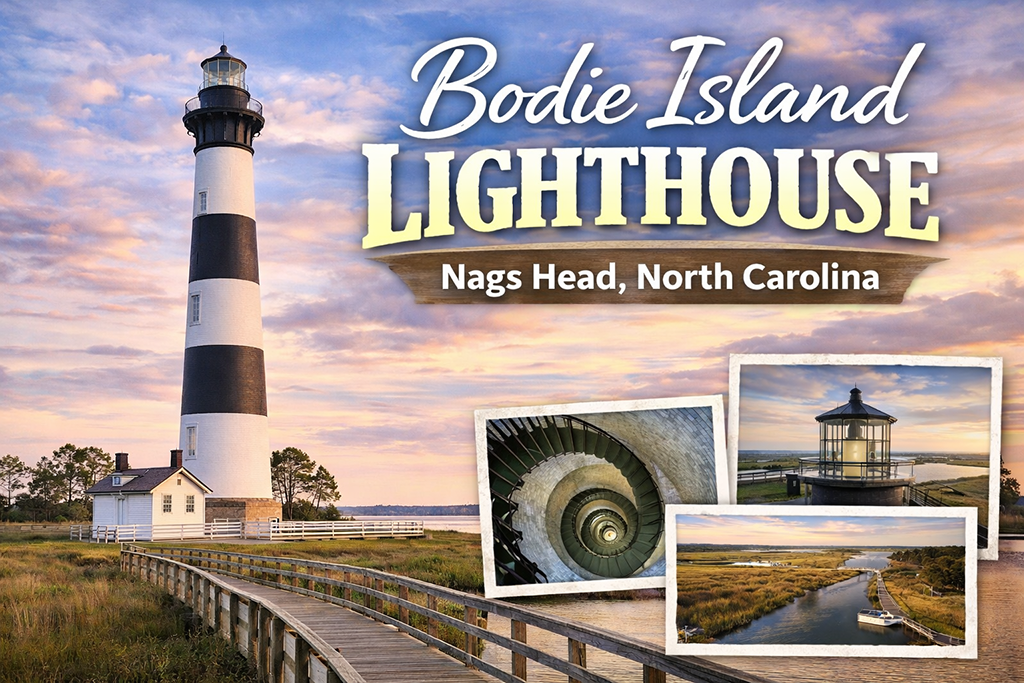
The current Bodie Island Lighthouse stands 156 feet tall and is the third lighthouse built along this stretch of coast. Its most distinctive feature is its daymark: wide, horizontal black-and-white bands. Those stripes were not decorative in the modern sense. They helped mariners identify the lighthouse during daylight hours and distinguish it from other coastal lights.
The lighthouse was equipped with a first-order Fresnel lens, the largest class of Fresnel lens used in American lighthouses. According to the National Park Service, that lens gave the light a range of more than 18 miles. This combination of height, optics, and placement made the lighthouse an important navigational aid for vessels approaching one of the most treacherous parts of the North Carolina coast.
The setting around the tower is part of its charm. Unlike some lighthouse visits that feel mostly architectural, Bodie Island’s surrounding marshes and boardwalks are a big part of the experience. Visit North Carolina notes that the boardwalks are especially good for birdwatching and photography, which helps explain why this stop is popular with both history lovers and nature photographers.
Why Bodie Island Lighthouse Is Worth Visiting
Bodie Island Lighthouse has a very balanced feel. It is historic without feeling too formal, scenic without requiring a full-day outing, and iconic without being overwhelming. For many visitors, it is one of the easiest Outer Banks lighthouse stops to fit into a travel day because it sits just south of Nags Head at the northern end of Cape Hatteras National Seashore.
It is also one of the better options for travelers who want an actual lighthouse climb. The National Park Service says the tower has just over 200 steps, about the equivalent of climbing a 10-story building, with nine landings along the way. That makes it a real climb, but still one that many active visitors can enjoy at their own pace.
Visitor Tips
If you are planning a visit, current National Park Service information says the Bodie Island Lighthouse is open seasonally for self-guided climbs, with the 2026 climb season listed as late April through mid-October. Tickets must be purchased online, and the park’s place page says they are bought the day of your visit through Recreation.gov.
There are a few important safety rules. Climbers must be at least 42 inches tall and able to climb all the steps on their own. Children 11 and younger must be accompanied by an adult age 16 or older. The NPS also says climbers must weigh less than 260 pounds, and only one person is allowed on each flight of stairs at a time.
The climb is not the only thing to know before you go. There is no entrance fee for Cape Hatteras National Seashore, but lighthouse climb tickets do cost extra. For 2026, NPS lists Bodie Island climb prices as $10 for adults and $5 for children under 12 and for seniors 62 and older.
One current detail worth noting is that the Bodie Island Double Keepers’ Quarters, which served as the visitor center and park store, is closed indefinitely because of internal damage from a January 2025 fire. The outdoor areas remain open for visiting, so you can still enjoy the lighthouse grounds and surrounding scenery.
For the best overall experience, many visitors pair the lighthouse with time on the boardwalks. The marsh setting makes this one of the prettiest lighthouse sites on the Outer Banks, especially for photos. Sunrise and sunset are often the most visually dramatic times of day there; that timing note is my recommendation based on photography conditions, while the boardwalk and photo appeal come from the cited sources.
Bodie Island Lighthouse is one of those Outer Banks landmarks that really lives up to expectations. It has a fascinating history, a striking design, and a location that feels both peaceful and memorable. Whether you come for the climb, the photography, the birdwatching, or simply to see one of North Carolina’s most recognizable lighthouses, it is a stop that adds a lot to an Outer Banks trip.