Details About Cape Hatteras Lighthouse
Discover the history, design, and visitor experience of Cape Hatteras Lighthouse, one of the most famous landmarks on the Outer Banks and a symbol of North Carolina’s coast.
OUTER BANKS LIGHTHOUSES
Jim Kernodle
3/13/20263 min read
Details About Cape Hatteras Lighthouse
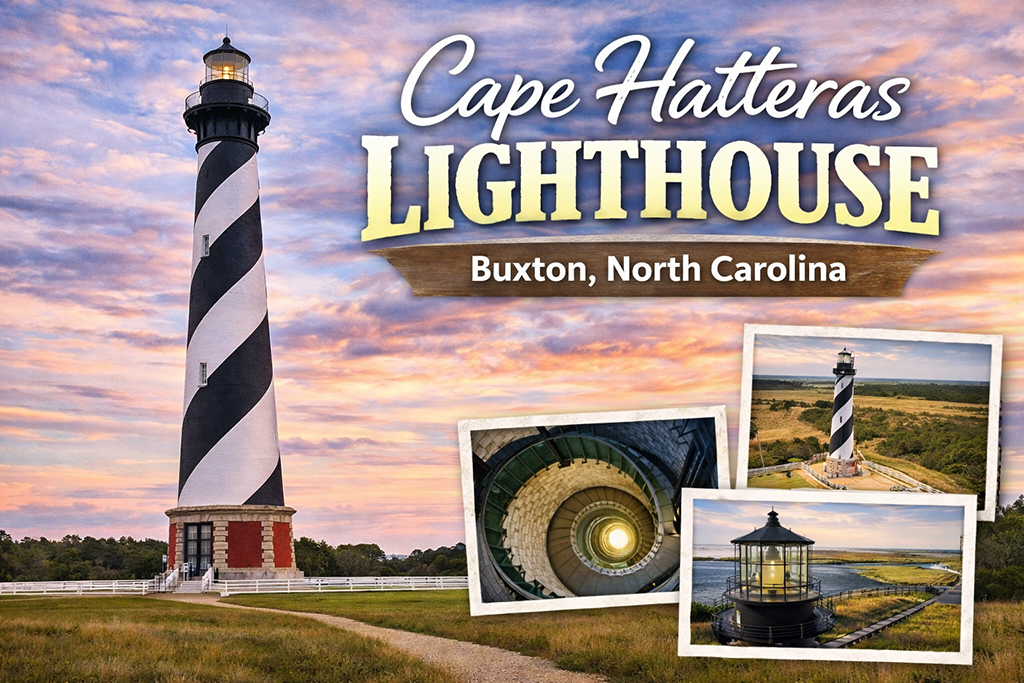
Cape Hatteras Lighthouse is one of the most recognizable sights on the Outer Banks, and for many visitors, it is the lighthouse they most want to see in person. Located in Buxton within Cape Hatteras National Seashore, it has long protected one of the most dangerous parts of the Atlantic coast, where currents and Diamond Shoals helped give this area its “Graveyard of the Atlantic” reputation.
What makes Cape Hatteras so memorable is that it is not just beautiful. It is also one of the most important engineering and preservation stories on the East Coast. Between its early history, its famous black-and-white spiral daymark, and its dramatic 1999 relocation, this lighthouse has far more depth than most visitors realize.
History
The story begins long before the current tower. Congress first authorized a lighthouse at Cape Hatteras in 1794, and the first lighthouse was completed and lit in 1803. That original sandstone tower stood 90 feet tall and used whale-oil lamps, but it turned out to be too short, too weak, and too hard to distinguish during the day to effectively warn ships away from the dangerous shoals offshore.
In 1853, the original tower was improved by adding 60 feet and installing a first-order Fresnel lens, which produced a much stronger beam. Even so, by the 1860s the structure needed extensive repairs, and Congress eventually funded a completely new lighthouse. Construction on the current tower began in 1868, and the new lighthouse was first lit on December 16, 1870. The original 1803 lighthouse was demolished a few months later, in 1871.
The familiar black-and-white spiral pattern did not arrive immediately. The Lighthouse Board ordered the daymark striping in 1873 so mariners could distinguish Cape Hatteras from other coastal lighthouses during daylight, while unique nighttime signals helped them identify it after dark.
Architecture
Cape Hatteras Lighthouse is impressive in both scale and construction. The National Park Service describes it as a conical brick structure rising from an octagonal brick-and-granite base and topped with an iron-and-glass lantern. It measures 198.49 feet from the bottom of the foundation to the top of the tower and is described by NPS as the tallest brick lighthouse in North America and the tallest traditional lighthouse in the United States.
One of the most interesting details is the foundation. Because groundwater was so high at the site, workers could not build in the usual way. Instead, foreman Dexter Stetson used a “floating foundation,” laying yellow pine timbers below the water table and placing granite plinths on top. That unusual solution helped the tower stand on a shifting barrier island landscape.
The tower was originally equipped with a first-order Fresnel lens transferred from the older lighthouse. Over time, the light source and technology changed: oil lamps gave way to other systems, the lamps were electrified in 1934, and the original Fresnel lens apparatus was eventually removed after vandalism. Today’s restoration project includes plans to replace the current spotlight-style beacon with a replica first-order Fresnel lens system that visitors will be able to see during future climbs.
The Move That Saved the Lighthouse
One of the most famous facts about Cape Hatteras Lighthouse is that it was moved. When the current tower was completed in 1870, it stood about 1,500 feet from the ocean. By 1970, erosion had brought the shoreline to roughly 120 feet away, putting the lighthouse in serious danger.
In 1999, the entire Cape Hatteras Light Station, including seven historic structures, was relocated 2,900 feet inland. The move was closely watched and widely debated, but it allowed the National Park Service to protect both the lighthouse and the historic relationship between the surrounding buildings. According to NPS, the lighthouse resumed service from its new location in November 1999.
Visitor Tips
Cape Hatteras is still absolutely worth visiting, but one current detail matters: the lighthouse will not be open for climbing in 2026 because of major restoration work. The outdoor areas around the lighthouse remain open 24/7, and the National Park Service also offers virtual experiences so visitors can still get a sense of the climb and the view from the top.
The restoration project is extensive. NPS says it includes masonry repairs, ironwork restoration, work on the lantern and windows, repainting, and landscape improvements for visitors. So even if the tower is closed for climbing right now, the closure is tied to preserving the lighthouse for the future.
The site also remains one of the easiest historic stops to add to an Outer Banks itinerary because it sits in Buxton, roughly in the middle of Cape Hatteras National Seashore. If you visit while climbing is unavailable, it still makes sense to walk the grounds, view the lighthouse up close, and check current park information before your trip since restoration updates can change over time.
Cape Hatteras Lighthouse is more than an iconic photo stop. It is a working symbol of Outer Banks history, coastal engineering, and long-term preservation. From its early 1803 beginnings to the 1870 tower, from its famous spiral daymark to its remarkable 1999 move, it tells one of the most compelling lighthouse stories in the United States.