Details About Ocracoke Lighthouse
Explore Ocracoke Lighthouse in Ocracoke Village, including its history, inlet-light design, architecture, and practical visitor tips for your trip.
OUTER BANKS LIGHTHOUSES
Red Rhyder
3/13/20264 min read
Details About Ocracoke Lighthouse
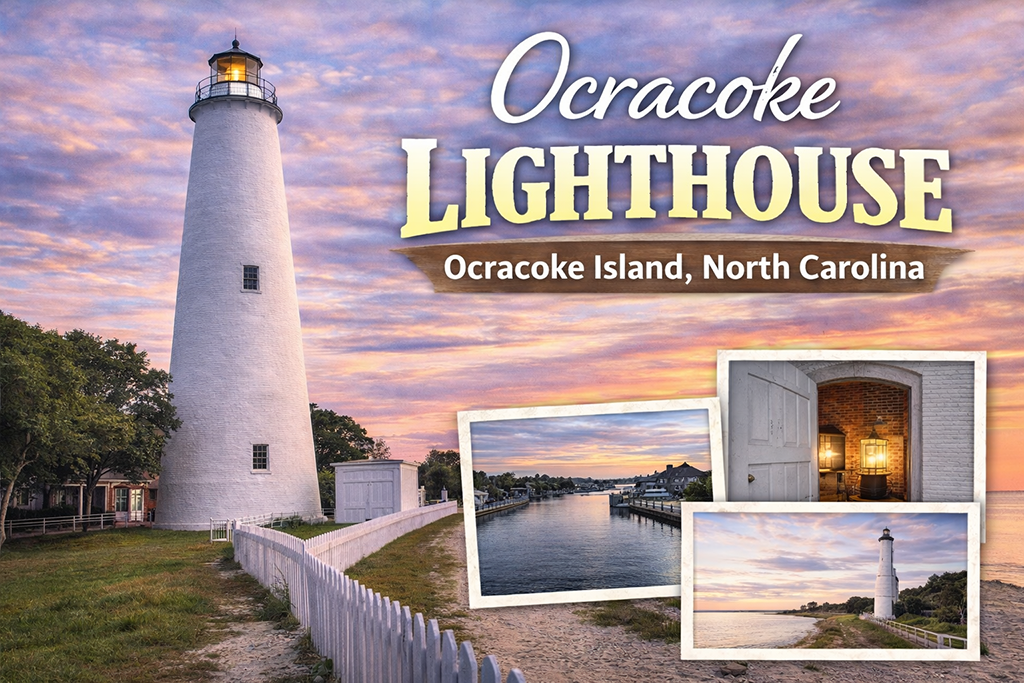
Ocracoke Lighthouse may be smaller and simpler than some of North Carolina’s more dramatic lighthouse towers, but that is exactly part of its charm. Located in Ocracoke Village at the southern end of Cape Hatteras National Seashore, it is the oldest operating lighthouse in North Carolina and one of the oldest operating lighthouses in the United States. Unlike Cape Hatteras or Bodie Island, Ocracoke was built as an inlet light, meaning its job was to guide ships safely through Ocracoke Inlet rather than warn vessels along the open coast.
What makes the lighthouse especially appealing is the way it fits its setting. It does not dominate the landscape with height or bold paint patterns. Instead, its smooth white tower rises quietly above the trees and village streets, giving Ocracoke a more intimate, lived-in lighthouse experience. It feels less like a grand monument and more like a steady part of island life, which is a big reason so many visitors remember it so fondly.
History
The history of Ocracoke Lighthouse goes back even earlier than the current tower. According to the National Park Service and the U.S. Coast Guard, the first beacon for this area was built on nearby Shell Castle Island in 1798 to help mariners through Ocracoke Inlet. That early light became ineffective as the channel shifted, and it was eventually destroyed, leaving a continuing need for a better navigation aid closer to the active passage.
Congress authorized a new lighthouse for Ocracoke Island in 1822. The federal government bought a two-acre site from Jacob Gaskill for $50, builder Noah Porter was awarded the contract, and the lighthouse and keeper’s quarters were completed in 1823. NPS historical research says the light was first exhibited on August 15, 1824, after delays that were not unusual for lighthouses of that era.
Ocracoke’s importance came from the inlet itself. NPS explains that Ocracoke Inlet was once one of the busiest inlets on the East Coast and an important route for ships reaching inland ports such as Elizabeth City, New Bern, and Edenton. Because the inlet and its shoals were constantly shifting, a dependable light remained necessary, and that is still true today.
Architecture
Ocracoke Lighthouse is modest in scale, but its design is one of the reasons it has endured. The tower stands about 75 feet tall, narrowing from roughly 25 feet in diameter at the base to about 12 feet at the top. NPS describes it as a secondary coastal light rather than a major first-order ocean beacon, which helps explain why it is shorter and simpler than the taller towers at Cape Hatteras or Bodie Island.
Its appearance is also distinctive in a very quiet way. Visit North Carolina notes that the walls are five feet thick at the base, and its smooth white stucco exterior reflects sunlight during the day. Instead of a rotating beacon, the lighthouse has long been known for a fixed light, creating a steady visual guide for mariners moving through the inlet and nearby waters.
A fourth-order Fresnel lens was installed in 1854, replacing the earlier reflector system and greatly intensifying the light. The National Park Service says the Coast Guard still owns and operates the light and Fresnel lens because the lighthouse remains an active aid to navigation, while the Park Service manages the surrounding historic site.
Why Ocracoke Lighthouse Is Special
One reason Ocracoke Lighthouse stands out is that it feels so different from the more famous striped lighthouses of North Carolina. There is no dramatic daymark, no big climb, and no towering height. Instead, there is a hand-built white tower that has been part of island life for two centuries. That simplicity gives it a personality all its own and makes it a natural symbol of Ocracoke’s independent, close-knit community.
It is also one of the easiest lighthouses to pair with the rest of the village experience. Visit North Carolina notes that the site is accessible by bike or on foot from Ocracoke Village, and the surrounding area makes it easy to combine a lighthouse stop with shops, restaurants, and a walk around Silver Lake Harbor. That relaxed setting makes this lighthouse especially appealing for travelers who enjoy slower, more scenic days.
Visitor Tips
The most important practical detail is that Ocracoke Lighthouse is not open for climbing. The National Park Service says the tower’s narrow design, small doors, and ladder access prevent public climbs. However, the site itself can be visited daily, and the base of the lighthouse opens for limited viewing hours during the summer months. For current base-access hours, NPS recommends checking with the Ocracoke Discovery Center.
Parking is limited, so it helps to plan ahead. NPS says the parking lot has only four regular spaces and one accessible space, and it recommends visiting the site by walking from the Ocracoke Island Visitor Center. For many travelers, biking or walking is actually part of the appeal, because the lighthouse fits naturally into the rhythm of the village rather than feeling like a separate attraction.
Because the lighthouse is small and unclimbable, it works best for visitors who appreciate history, atmosphere, and photography more than a big adventure-style stop. Visit North Carolina notes that the grounds can be explored and photographed, and that the island setting is especially pleasant in the morning or late afternoon. That timing suggestion is more of a travel recommendation than an official rule, but it fits the quiet character of the site well.
Ocracoke Lighthouse does not need to be the tallest or most elaborate lighthouse on the coast to be memorable. Its importance comes from its age, its continuing role as a working navigational aid, and the way it belongs so naturally to Ocracoke Village. For visitors who want a lighthouse stop with history, character, and a strong sense of place, Ocracoke is one of the most rewarding lighthouse visits in North Carolina.