Details About the Currituck Beach Lighthouse
Learn key details about the Currituck Beach Lighthouse, including its history, height, climb, lens, and what to expect when visiting Corolla.
OUTER BANKS LIGHTHOUSES
Jim Kernodle
3/13/20263 min read
Details About the Currituck Beach Lighthouse
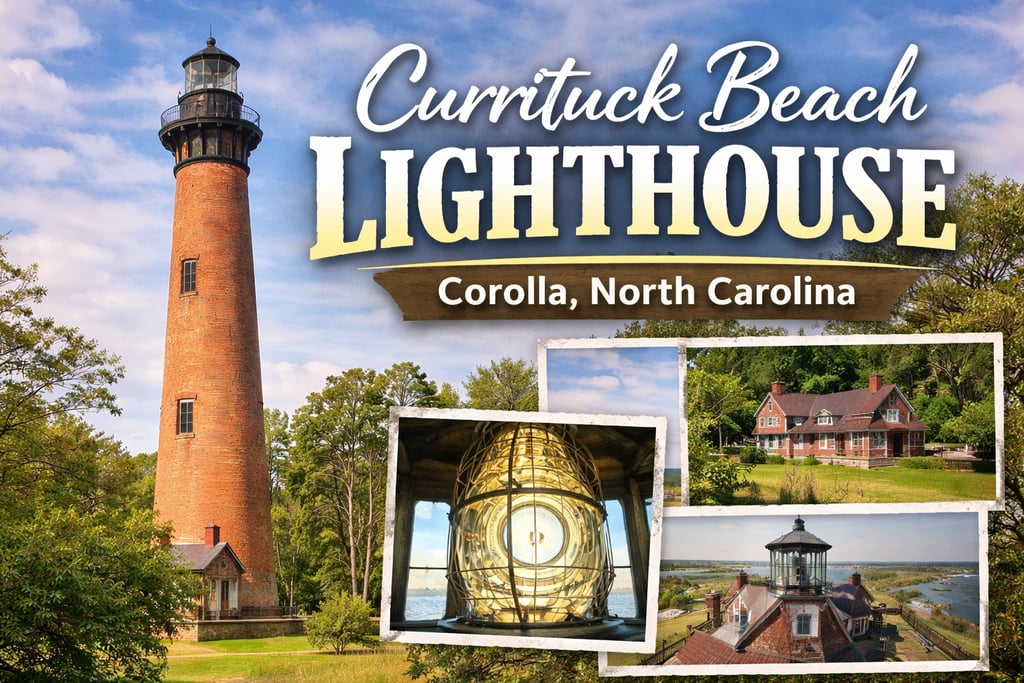
The Currituck Beach Lighthouse is one of the most distinctive landmarks on North Carolina’s Outer Banks. Located in Historic Corolla Village, it stands out right away because of its unpainted red-brick exterior, which was intentionally left bare so mariners could identify it during the day. Unlike the striped patterns seen on some other coastal lighthouses, Currituck’s natural brick became its own visual signature.
History of the Currituck Beach Lighthouse
The story of the lighthouse begins in 1873, when Congress funded a beacon for the last dark stretch of coast between Cape Henry, Virginia, and Bodie Island, North Carolina. Construction began in 1874, and the lighthouse was first illuminated on December 1, 1875. Its purpose was practical and urgent: to help ships navigate a dangerous section of coastline that previously had no direct light coverage.
Currituck Beach Lighthouse was also the last large lighthouse tower built on the Outer Banks. That gives it a special place in North Carolina maritime history, because it marked the completion of a major era of coastal lighthouse construction in the region.
The lighthouse was staffed by keepers and their families for decades. According to the official history, more than two dozen families lived in the duplex Keepers’ Dwelling and were responsible for making sure the light remained active and rotating. The light was later automated in 1939 under U.S. Coast Guard control, ending the traditional keeper era.
Architecture and Design
One of the most memorable details about the Currituck Beach Lighthouse is its appearance. The tower rises 162 feet and is known for its red-brick exterior, a look that makes it very different from the black-and-white painted lighthouses many visitors expect to see on the Outer Banks. That unpainted brick was not an accident. It functioned as a daymark, helping sailors tell this lighthouse apart from others along the coast.
The lighthouse is also known for its first-order Fresnel lens, the largest of the seven Fresnel lens sizes. North Carolina’s tourism site notes that it is one of only a few lighthouses in the United States that still houses its original first-order Fresnel lens, and that lens continues to flash today at 20-second intervals. The beam can be seen for 18 nautical miles.
Why the Currituck Beach Lighthouse Matters
What makes the Currituck Beach Lighthouse especially meaningful is that it was built to solve a real navigation problem. Before it was lit, this section of coast remained a dark gap between other major lighthouses. By filling that gap, Currituck improved safety for ships traveling along the northern Outer Banks and became an important part of the region’s maritime network.
It also remains important today because it is not just a historic structure. The light still operates, and the site continues to be preserved by Outer Banks Conservationists. The official history notes that the organization has carried out preservation and restoration work over many years to protect the tower and the surrounding compound.
Visiting the Currituck Beach Lighthouse
For visitors, the Currituck Beach Lighthouse offers more than a quick photo stop. The grounds are free to enter, and the site includes exhibits and a museum shop. From the top of the tower, climbers can see the Currituck Sound, the Atlantic Ocean, and the northern Outer Banks, which is one reason the lighthouse remains such a popular stop in Corolla.
According to the official 2026 visitor page, the season runs from March 21 through November 30, and the lighthouse and museum shop are open daily from 9 a.m. to 5 p.m., weather permitting. The site notes that it may close during thunder, major storms, and on Thanksgiving Day.
The current climbing fee is $13 for ages 4 and up, and advance online ticketing is not available. The official site also says there are no height restrictions, but climbers must be at least 4 years old, while children ages 0 to 3 may only go to the top in a carrier or backpack. Visitors must sign a liability waiver before climbing.
Another detail many travelers appreciate is the setting. Because the lighthouse sits in Historic Corolla Village, it fits easily into a relaxed day of sightseeing. Visitors can pair it with nearby historic attractions and enjoy a slower-paced northern Outer Banks stop that feels both scenic and meaningful.
What to Expect from the Climb
The climb is one of the main reasons people visit. The official site describes the experience as rewarding, with expansive views at the top. Visitor information on the site also references 220 steps, so it is a good idea to be prepared for a real stair climb rather than a short walk-up.
For many travelers, that climb is worth it because Currituck offers a different feel from the more famous striped lighthouses farther south. Its warm brick color, village setting, and sweeping water views give it a character that feels both historic and welcoming.
The Currituck Beach Lighthouse is more than just a beautiful tower in Corolla. It is a working piece of coastal history that helped light a dangerous stretch of shoreline, still houses its original first-order Fresnel lens, and remains one of the most visually distinctive lighthouses in the Outer Banks. For visitors who want history, scenery, and a memorable climb all in one stop, it is one of the best lighthouse experiences in North Carolina.