First-Time Visitor’s Guide to the Outer Banks
Planning your first trip to the Outer Banks? This beginner-friendly guide covers where to stay, what to do, when to visit, and helpful tips for making the most of your OBX vacation.
OUTER BANKS LIGHTHOUSES
Red Rhyder
3/12/20263 min read
First-Time Visitor’s Guide to the Outer Banks
If you are planning your first trip to the Outer Banks, the best approach is to keep things simple: choose a good home base, build a flexible itinerary, and leave room for beach time, scenic drives, and a few iconic stops. The Outer Banks is spread across multiple towns and villages rather than one compact destination, so it helps to think of the trip by region instead of trying to do everything at once. Official Outer Banks planning resources also recommend booking accommodations in advance, especially during the peak summer season.
One of the easiest mistakes first-time visitors make is underestimating distance. The official Outer Banks tourism site notes roughly 20 miles from Kitty Hawk to Manteo, 63 miles from Manteo to Hatteras Village, and 78 miles from Duck to Hatteras Village. That means your vacation will feel much smoother if you pick one primary area to stay in and group your activities nearby instead of constantly driving up and down the islands.
For many first visits, the central and northern Outer Banks make a practical starting point because they put you within reach of several of the area’s best-known attractions. Wright Brothers National Memorial is in Kill Devil Hills, and Jockey’s Ridge State Park is in Dare County on the Outer Banks, where visitors will find the tallest living sand dune system on the Atlantic coast along with sunsets, kite flying, hang gliding, and soundside recreation. If your priority is a classic “see the highlights” trip, building your days around this part of the Outer Banks is an easy way to start.
If your dream trip leans more toward wide-open beaches, lighthouse views, and a quieter national seashore experience, head farther south. Cape Hatteras National Seashore offers beaches, salt marshes, kayaking, and the Cape Hatteras Lighthouse, and the official Outer Banks lighthouse guide highlights the region’s beacons as some of the defining landmarks of the coast. A southern base makes more sense when your priority is long beach days, lighthouse stops, and a slower-paced island feel.
As for what to do, first-timers usually do best with a mix of history, scenery, and relaxed beach time. A strong first itinerary often includes one lighthouse stop, one major historic site, one sunset outing, and one open day for simply enjoying the beach. The Outer Banks tourism authority highlights lighthouses, attractions, beaches, and outdoor activities as core experiences, while the national park and state park sites make clear that Wright Brothers National Memorial and Jockey’s Ridge are two of the area’s signature stops.
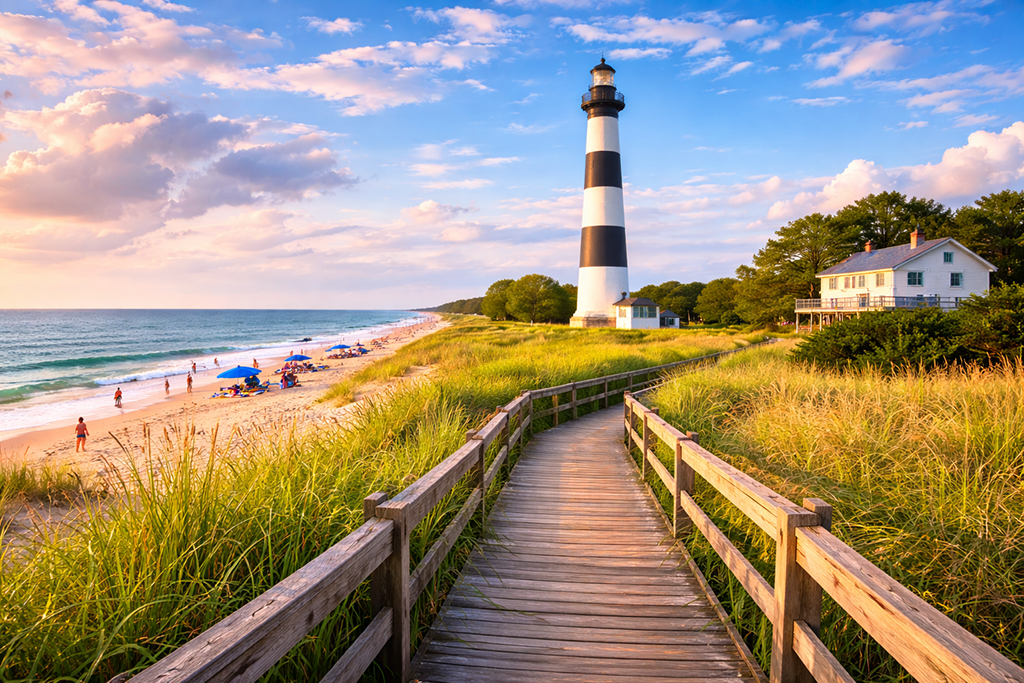
Lighthouse fans have plenty to choose from. The official Outer Banks lighthouse guide emphasizes that these beacons have guarded the coast for more than two centuries, and the National Park Service notes that Bodie Island Light Station sits at the northern end of Cape Hatteras National Seashore. For a first trip, Bodie Island is an easy and rewarding stop because it pairs well with Nags Head, Roanoke Island, and the drive south toward Hatteras.
If Ocracoke is on your list, plan that day carefully. The official ferry page notes that ferry travel is a common and important part of getting around the Outer Banks, and it lists the Hatteras-to-Ocracoke vehicle ferry as a roughly 60-minute crossing with no reservations accepted, while the Ocracoke Express passenger ferry takes about 70 minutes. Longer toll ferry routes also connect Ocracoke with Cedar Island and Swan Quarter. For first-time visitors, the biggest takeaway is simple: check ferry schedules before your trip and build extra time into your day.
Timing matters too. The official Outer Banks weather and seasons page says spring brings rising air and water temperatures, with many shops and restaurants beginning to open after Easter and daytime temperatures often reaching the mid-60s to 70s. Summer is the classic beach season, and the official planning page notes that summer is peak time for accommodations, which is why booking early is smart if you want the widest choice of rentals and hotels.
For a first trip, a good rule is to avoid overscheduling. The Outer Banks works best when you leave room for the things that happen naturally there: stopping at a scenic overlook, lingering on a boardwalk, watching the light change over the dunes, or deciding on the spot to stay for sunset. The destination’s official planning resources are built around exactly that kind of trip—choosing a place to stay, exploring nearby towns and attractions, and giving yourself time to enjoy the coast instead of racing through it.
A few final tips can make a first visit much easier. Book lodging early for summer, check ferry schedules if Ocracoke is part of your plan, review current weather and seasonal conditions before long driving days, and confirm attraction hours directly with the official sites for places like Cape Hatteras, Bodie Island, Wright Brothers National Memorial, and Jockey’s Ridge. A little planning goes a long way in the Outer Banks, and it leaves you free to enjoy what makes the area special: open beaches, unforgettable landmarks, and a slower coastal rhythm.