Outer Banks Lighthouse Facts Most Visitors Don’t Know
Discover surprising Outer Banks lighthouse facts most travelers miss, from hidden history and unusual daymarks to the massive move of Cape Hatteras Lighthouse.
OUTER BANKS LIGHTHOUSES
Jim Kernodle
3/30/20264 min read
Outer Banks Lighthouse Facts Most Visitors Don’t Know
The Outer Banks is famous for its beaches, wild scenery, and postcard-worthy lighthouses. But while most visitors recognize the black-and-white stripes of Cape Hatteras or the red brick tower in Corolla, many don’t realize how much history, engineering, and local lore are packed into these coastal landmarks. From unusual paint patterns to one of the most famous lighthouse moves in America, the stories behind these towers are just as memorable as the views.
The black-and-white patterns were not just for looks
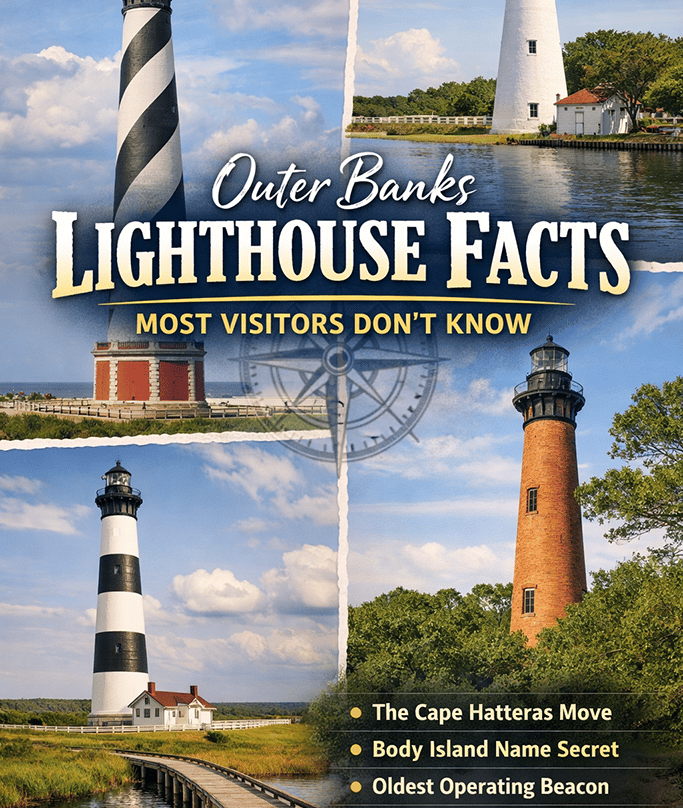
The bold designs on Outer Banks lighthouses were created as daymarks, which helped sailors tell one lighthouse from another during daylight hours. At Cape Hatteras, the famous black-and-white spiral pattern was added in 1873, and the Lighthouse Board also assigned each station a unique light signal at night so mariners could identify them after dark as well.
“Bodie” Island is actually pronounced “Body”
Many first-time visitors say “Bo-dee,” but locals and official sources note that Bodie is pronounced like “Body.” That little fact surprises plenty of travelers, especially because the lighthouse is one of the most photographed stops in the Outer Banks. Even more interesting, the current Bodie Island Lighthouse is actually the third lighthouse built in that area.
Cape Hatteras is the tallest brick lighthouse in the United States
Cape Hatteras Lighthouse is not just iconic. It is also enormous. The current tower measures 198.49 feet from the bottom of its foundation to the top of the pinnacle, making it the tallest brick lighthouse in the United States. Its height was necessary because the dangerous Diamond Shoals offshore made a powerful warning light especially important.
Cape Hatteras Lighthouse was moved in one of the most famous engineering projects on the coast
One of the most amazing Outer Banks facts is that Cape Hatteras Lighthouse did not always stand where it does today. In 1999, the entire light station was relocated 2,900 feet inland because shoreline erosion had brought the Atlantic dangerously close to the tower. The move preserved not just the lighthouse, but the surrounding historic buildings as well.
The Cape Hatteras tower you see today was not the first one
A lot of visitors assume the striped lighthouse has always been there, but the first Cape Hatteras lighthouse was lit in 1803. That original tower turned out to be too short and not visible enough for the dangerous waters offshore, so a new lighthouse was eventually built and lit in 1870. In other words, the famous tower standing today replaced an earlier version that simply could not do the job well enough.
Ocracoke Lighthouse is different from the others because it is an inlet light
Unlike the other major Outer Banks lighthouses, Ocracoke was built to guide ships through Ocracoke Inlet, not just along the open coast. That makes it an inlet light, which is one reason it looks and functions a little differently from the taller towers many visitors expect. It may be smaller and simpler in appearance, but it played a vital role in navigation through shifting channels and shoals.
Ocracoke Lighthouse is one of the oldest operating lighthouses in America
Ocracoke Lighthouse was built in 1823, and it remains the oldest working lighthouse in North Carolina. According to the National Park Service, it is also the second oldest operating lighthouse in the United States. That means when you visit Ocracoke, you are seeing one of the country’s oldest still-functioning navigational landmarks.
Currituck Beach Lighthouse was left unpainted on purpose
Most people expect coastal lighthouses to be painted in bold patterns, but the Currituck Beach Lighthouse stands out because its red brick exterior was never painted. That was intentional. Its unpainted brick served as its own daytime identifier, helping sailors distinguish it from other North Carolina lighthouses. It was also the last brick and mortar lighthouse built in North Carolina.
Currituck was built to light up a dangerous “dark space”
Currituck Beach Lighthouse was not added just to make the coastline prettier. It was built because there was a long stretch of coast without a lighthouse, described in state history sources as about 40 miles of “dark space.” When the beacon was first lit in 1875, it filled that gap between the lights to the north and south and improved safety for ships traveling that section of the coast.
Not every Outer Banks lighthouse offers the same visitor experience
A lot of travelers assume every lighthouse can be climbed, but that is not the case. Ocracoke Lighthouse site can be visited, but the lighthouse itself is not open for climbing. Bodie Island Lighthouse has just over 200 steps, while Currituck Beach Lighthouse has 220 steps to the top. That is one reason it is smart to check the official site for the lighthouse you want to visit before planning your day.
Fresnel lenses were a huge leap forward in lighthouse technology
Part of what made many of these lighthouses so effective was the Fresnel lens, which used specially cut glass to intensify and focus light into a stronger beam. The National Park Service notes that first-order Fresnel lenses were among the largest used on major seacoasts. Currituck’s lighthouse is a first-order lighthouse, and Bodie Island is also associated with a powerful first-order lens.
Outer Banks lighthouses are more than scenic stops for vacation photos. They are working pieces of maritime history, shaped by storms, engineering challenges, changing coastlines, and the needs of sailors traveling one of the most dangerous stretches of shoreline on the East Coast. Once you know the stories behind them, each visit feels a little more meaningful.